


Stumbled across a possible 2"primary LSJ Header?..


Thread Starter
New Member
Joined: 05-11-05
Posts: 20
Likes: 0
From: Buffalo, NY
Stumbled across a possible 2"primary LSJ Header?..
I was poking around the J-body site and another ecotec s and one of their members had a 2" primary made for his Supercharged cavalier and IIRC these should just bolt in correctly? He said the company had a jig to reproduce them. From the pictures he posted up it looks like an extremely nice header since its all Stainless steel, I'm just wondering is that extra .25" over the pacesetter LSJ header going to be noticeable? I'm looking for the best and largest free flowing exahust I can slap onto my LSJ and this seems to be it.
Couple pictures for reference..
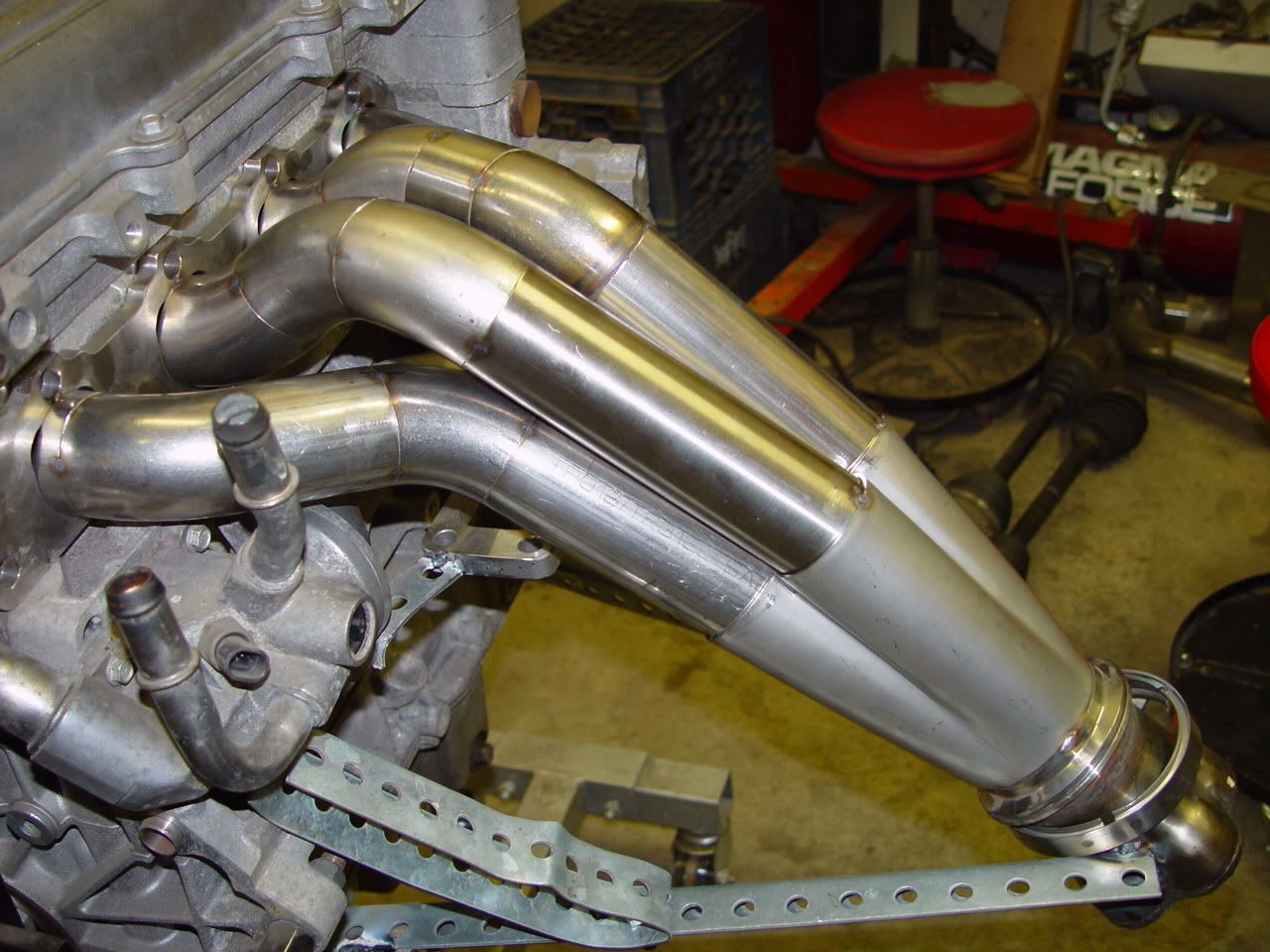
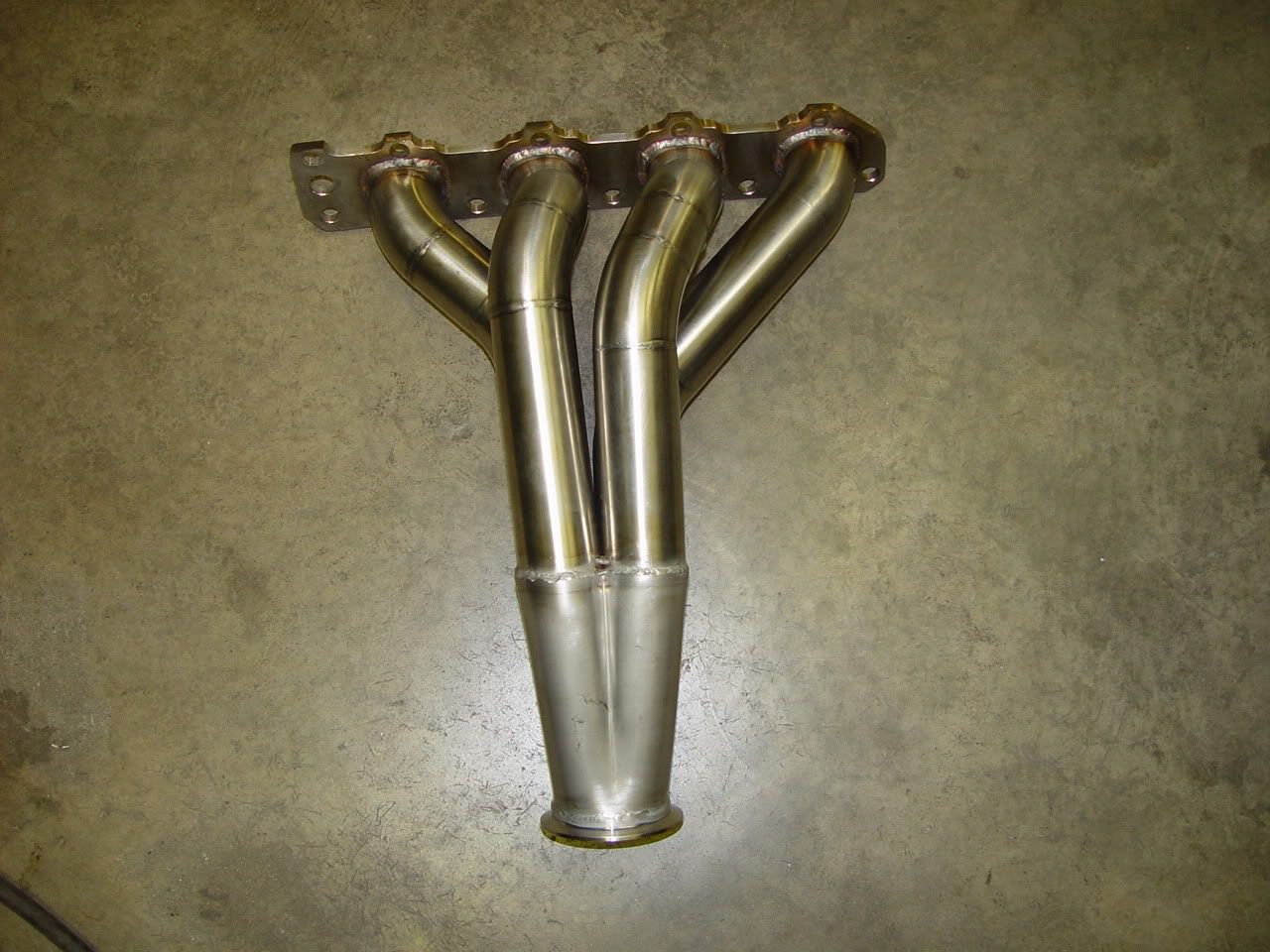

I guess I'm just looking for some more feedback from you guys before dropping the amount of coin this guy did for his, Thanks in Advance!
Couple pictures for reference..
I guess I'm just looking for some more feedback from you guys before dropping the amount of coin this guy did for his, Thanks in Advance!

Damm thats a very nice looking header you let me know when that goes on sale and I'll pick it up, and .25 will do a little more by freeing and flowing better how much better I really cant give you an exact number but..Let me know when on sale if they're going to be


Banned
Joined: 06-23-05
Posts: 8,004
Likes: 0
From: ky
honestly it's not worth it think about this:
4 x 1.5" = 6" area for exhaust to travel through
4 x 1.75 = 7" area
4 x 2" = 8" area
all three of which, go right into at the biggest a 1 x 3" pipe. this is why i find it funny when people argue about how much better a 1.75" primary header is than a 1.5" primary header the more volume you have, the slower the velocity. the slower the velocity, the less scavenging effect you have. so bigger on everything, isn't always better.
4 x 1.5" = 6" area for exhaust to travel through
4 x 1.75 = 7" area
4 x 2" = 8" area
all three of which, go right into at the biggest a 1 x 3" pipe. this is why i find it funny when people argue about how much better a 1.75" primary header is than a 1.5" primary header
the more volume you have, the slower the velocity. the slower the velocity, the less scavenging effect you have. so bigger on everything, isn't always better.
Thread Starter
New Member
Joined: 05-11-05
Posts: 20
Likes: 0
From: Buffalo, NY
honestly it's not worth it think about this:
4 x 1.5" = 6" area for exhaust to travel through
4 x 1.75 = 7" area
4 x 2" = 8" area
all three of which, go right into at the biggest a 1 x 3" pipe. this is why i find it funny when people argue about how much better a 1.75" primary header is than a 1.5" primary header the more volume you have, the slower the velocity. the slower the velocity, the less scavenging effect you have. so bigger on everything, isn't always better.
4 x 1.5" = 6" area for exhaust to travel through
4 x 1.75 = 7" area
4 x 2" = 8" area
all three of which, go right into at the biggest a 1 x 3" pipe. this is why i find it funny when people argue about how much better a 1.75" primary header is than a 1.5" primary header
the more volume you have, the slower the velocity. the slower the velocity, the less scavenging effect you have. so bigger on everything, isn't always better.If I were N/A I would be siding with you because of the motors need for back pressure.
As for fittment on my cobalt another member on there with a cobalt says it will... here is the link.
http://www.ecotecforum.com/forums/sh...ad.php?t=12093

Banned
Joined: 12-18-05
Posts: 17,838
Likes: 1
From: North Jersey
I thought when your boosted that didn't matter, the fastest you can ex spell the exhaust gases the better and less restrictive the better.
If I were N/A I would be siding with you because of the motors need for back pressure.
As for fittment on my cobalt another member on there with a cobalt says it will... here is the link.
http://www.ecotecforum.com/forums/sh...ad.php?t=12093
If I were N/A I would be siding with you because of the motors need for back pressure.
As for fittment on my cobalt another member on there with a cobalt says it will... here is the link.
http://www.ecotecforum.com/forums/sh...ad.php?t=12093
Banned
Joined: 06-23-05
Posts: 8,004
Likes: 0
From: ky
they do for mid and low range torque
Last edited by selfinfliction; Nov 19, 2009 at 02:43 PM. Reason: Automerged Doublepost
Banned
Joined: 12-18-05
Posts: 17,838
Likes: 1
From: North Jersey
that's not necessarily true with supercharged engines. on the exhaust side, superchargers are identical to n/a exhaust cycles (unless of course the cam overlaps) turbos are different and work best with the least restrictive system.
they do for mid and low range torque
they do for mid and low range torque

Senior Member
Joined: 10-06-05
Posts: 10,944
Likes: 2
From: Seneca, South Carolina
there is some flawed logic in this thread, but that header looks pretty good, and would be necessary for high hp, but I can't see a blown or n/a ecotec motor making enough to use that.
Banned
Joined: 06-23-05
Posts: 8,004
Likes: 0
From: ky
3. John Grudinsky at HyTech Exhausts comments on the usefulness of backpressure:
quote:
I have seen where a little backpressure, helped out the very low end of a 4-cycle engine because it
had a lot of valve timing and it stopped some of the scavenging of the cylinder and (therefore) helped
the power. But as the motor revved up, the gains were diminished and it lost power on top (in the
upper rpms). There has been exhaust systems designed to actually reverse feed the cylinder through
the exhaust port, before the valve closes on overlap. It actually has worked, but it didn't seem to work
over a large rpm band but in a short (rpm) one, it worked quite well.
quote:
I have seen where a little backpressure, helped out the very low end of a 4-cycle engine because it
had a lot of valve timing and it stopped some of the scavenging of the cylinder and (therefore) helped
the power. But as the motor revved up, the gains were diminished and it lost power on top (in the
upper rpms). There has been exhaust systems designed to actually reverse feed the cylinder through
the exhaust port, before the valve closes on overlap. It actually has worked, but it didn't seem to work
over a large rpm band but in a short (rpm) one, it worked quite well.
At less than WOT and peak power rpm, the diameter of the tubing should change in ID. Just as with
intake ports (unless we're just running off port volume), cross sectional area should be only sufficient
to supply the flow rate necessary to feed the engine.
High velocities, that don't incur pumping losses are the rule.
The exhaust system is much the same. Just changing backpressure is a bogus way of trying to create
the "ideal" pressure in the system. The exhaust system should work like a correctly conceived header.
It should extract the exhaust from the header, to minimize pumping pressures.
The only way to create a system that will serve as an extractor is to properly size the tubing to allow
the flow velocity to create a sort of "vacuum" behind it.
intake ports (unless we're just running off port volume), cross sectional area should be only sufficient
to supply the flow rate necessary to feed the engine.
High velocities, that don't incur pumping losses are the rule.
The exhaust system is much the same. Just changing backpressure is a bogus way of trying to create
the "ideal" pressure in the system. The exhaust system should work like a correctly conceived header.
It should extract the exhaust from the header, to minimize pumping pressures.
The only way to create a system that will serve as an extractor is to properly size the tubing to allow
the flow velocity to create a sort of "vacuum" behind it.
Banned
Joined: 06-23-05
Posts: 8,004
Likes: 0
From: ky
you didn't read the second part. the first part speaks about how backpressure works on low end torque, just as i said, and you said it in no way helps anything.
the second part covers the scavenging necessity with properly sized piping and the least restriction on the backpressure. meaning it doesn't want the piston to exert much energy pumping the exhaust out and it needs a vacuum (velocity) to do this
there are plenty of articles on this exact topic that are available and written by extremely credible sources.
I will not ever argue the fact that running WOT will not benefit from the least restrictive system BUT BUT BUT 0.5% of people here have a track only race car. you will see more benefits 99% of the time by a properly sized exhaust, and not just some humongo system. all it does is make alot more noise for no reason and no gains when partial throttle
the second part covers the scavenging necessity with properly sized piping and the least restriction on the backpressure. meaning it doesn't want the piston to exert much energy pumping the exhaust out and it needs a vacuum (velocity) to do this
there are plenty of articles on this exact topic that are available and written by extremely credible sources.
I will not ever argue the fact that running WOT will not benefit from the least restrictive system BUT BUT BUT 0.5% of people here have a track only race car. you will see more benefits 99% of the time by a properly sized exhaust, and not just some humongo system. all it does is make alot more noise for no reason and no gains when partial throttle

Senior Member
Joined: 10-14-06
Posts: 3,623
Likes: 1
From: Vancouver, BC
yea backpressure....we ALL must have backpressure...infact we should put a supercharger or turbo in such a way that it blows INTO the exhaust mani somhow..i dunno someone will invent it..then i'll be winning all my races with all my backpressure and u'll all be crying in ur corners on how ur car did a 14 flat and mine did a 3 second 300 mph pass bitches
Banned
Joined: 12-18-05
Posts: 17,838
Likes: 1
From: North Jersey
I didn't read the 2nd part?? you left out the rest of the article "conveniently" lol... maybe you should try reading the whole article.
I never argued that proper sized exhaust is not the best way to go lol... the 2nd paragraph says nothing about backpressure being good.
Secondly, again, how does this apply to cobalts? are you saying that we have too much valve timing and need the backpressure to make up for some of that? come on man.
This is taken from the same article you posted
Few tests have been done that clearly show the effect of changing back pressure. Most muffler and exhaust comparison tests change more than one parameter simultaneously, making the identification of exhaust backpressure as a culprit difficult.
However, Wollongong (Australia) mechanic Kevin Davis has done extensive testing of varying backpressure on a number of performance engines.
These range from turbocharged Subaru Legacy RS flat fours to full-house traditional pushrod V8s. In not one case has he found any improvement in any engine performance parameter with increased exhaust backpressure.
The tests came about because Kevin has developed a patented variable-flow exhaust that uses a butterfly within the exhaust pipe. He initially expected to use the system to cause some backpressure at low loads 'to help torque.'
However, he soon changed his mind when any increase in back pressure proved to decrease torque on a properly tuned engine. What increasing the backpressure does do is dramatically quiet the exhaust.
this was also in that article:
As you'll see later, very few exhausts are capable of delivering such a low backpressure on a road car.
Even with this small amount of backpressure, peak torque dropped by 4 per cent and peak power by 5 per cent. He then changed the exhaust to give 2.5-psi backpressure. Torque and power decreased again, both dropping by 7 per cent over having zero backpressure. These results were achieved on a large engine with a large overlap cam - one of the types some people suggest is 'supposed' to like backpressure.
If, in fact, power does increase with increased exhaust back pressure, it is most likely the air/fuel ratio and/or ignition timing that are no longer optimal for the altered state of engine tune."
I never argued that proper sized exhaust is not the best way to go lol... the 2nd paragraph says nothing about backpressure being good.
Secondly, again, how does this apply to cobalts? are you saying that we have too much valve timing and need the backpressure to make up for some of that? come on man.
This is taken from the same article you posted
Few tests have been done that clearly show the effect of changing back pressure. Most muffler and exhaust comparison tests change more than one parameter simultaneously, making the identification of exhaust backpressure as a culprit difficult.
However, Wollongong (Australia) mechanic Kevin Davis has done extensive testing of varying backpressure on a number of performance engines.
These range from turbocharged Subaru Legacy RS flat fours to full-house traditional pushrod V8s. In not one case has he found any improvement in any engine performance parameter with increased exhaust backpressure.
The tests came about because Kevin has developed a patented variable-flow exhaust that uses a butterfly within the exhaust pipe. He initially expected to use the system to cause some backpressure at low loads 'to help torque.'
However, he soon changed his mind when any increase in back pressure proved to decrease torque on a properly tuned engine. What increasing the backpressure does do is dramatically quiet the exhaust.
this was also in that article:
As you'll see later, very few exhausts are capable of delivering such a low backpressure on a road car.
Even with this small amount of backpressure, peak torque dropped by 4 per cent and peak power by 5 per cent. He then changed the exhaust to give 2.5-psi backpressure. Torque and power decreased again, both dropping by 7 per cent over having zero backpressure. These results were achieved on a large engine with a large overlap cam - one of the types some people suggest is 'supposed' to like backpressure.
If, in fact, power does increase with increased exhaust back pressure, it is most likely the air/fuel ratio and/or ignition timing that are no longer optimal for the altered state of engine tune."
Last edited by D4u2s0t; Nov 19, 2009 at 03:18 PM. Reason: Automerged Doublepost
Senior Member
Joined: 10-14-06
Posts: 3,623
Likes: 1
From: Vancouver, BC
I didn't read the 2nd part?? you left out the rest of the article "conveniently" lol... maybe you should try reading the whole article.
I never argued that proper sized exhaust is not the best way to go lol... the 2nd paragraph says nothing about backpressure being good.
Secondly, again, how does this apply to cobalts? are you saying that we have too much valve timing and need the backpressure to make up for some of that? come on man.
This is taken from the same article you posted
Few tests have been done that clearly show the effect of changing back pressure. Most muffler and exhaust comparison tests change more than one parameter simultaneously, making the identification of exhaust backpressure as a culprit difficult.
However, Wollongong (Australia) mechanic Kevin Davis has done extensive testing of varying backpressure on a number of performance engines.
These range from turbocharged Subaru Legacy RS flat fours to full-house traditional pushrod V8s. In not one case has he found any improvement in any engine performance parameter with increased exhaust backpressure.
The tests came about because Kevin has developed a patented variable-flow exhaust that uses a butterfly within the exhaust pipe. He initially expected to use the system to cause some backpressure at low loads 'to help torque.'
However, he soon changed his mind when any increase in back pressure proved to decrease torque on a properly tuned engine. What increasing the backpressure does do is dramatically quiet the exhaust.
this was also in that article:
As you'll see later, very few exhausts are capable of delivering such a low backpressure on a road car.
Even with this small amount of backpressure, peak torque dropped by 4 per cent and peak power by 5 per cent. He then changed the exhaust to give 2.5-psi backpressure. Torque and power decreased again, both dropping by 7 per cent over having zero backpressure. These results were achieved on a large engine with a large overlap cam - one of the types some people suggest is 'supposed' to like backpressure.
If, in fact, power does increase with increased exhaust back pressure, it is most likely the air/fuel ratio and/or ignition timing that are no longer optimal for the altered state of engine tune."
I never argued that proper sized exhaust is not the best way to go lol... the 2nd paragraph says nothing about backpressure being good.
Secondly, again, how does this apply to cobalts? are you saying that we have too much valve timing and need the backpressure to make up for some of that? come on man.
This is taken from the same article you posted
Few tests have been done that clearly show the effect of changing back pressure. Most muffler and exhaust comparison tests change more than one parameter simultaneously, making the identification of exhaust backpressure as a culprit difficult.
However, Wollongong (Australia) mechanic Kevin Davis has done extensive testing of varying backpressure on a number of performance engines.
These range from turbocharged Subaru Legacy RS flat fours to full-house traditional pushrod V8s. In not one case has he found any improvement in any engine performance parameter with increased exhaust backpressure.
The tests came about because Kevin has developed a patented variable-flow exhaust that uses a butterfly within the exhaust pipe. He initially expected to use the system to cause some backpressure at low loads 'to help torque.'
However, he soon changed his mind when any increase in back pressure proved to decrease torque on a properly tuned engine. What increasing the backpressure does do is dramatically quiet the exhaust.
this was also in that article:
As you'll see later, very few exhausts are capable of delivering such a low backpressure on a road car.
Even with this small amount of backpressure, peak torque dropped by 4 per cent and peak power by 5 per cent. He then changed the exhaust to give 2.5-psi backpressure. Torque and power decreased again, both dropping by 7 per cent over having zero backpressure. These results were achieved on a large engine with a large overlap cam - one of the types some people suggest is 'supposed' to like backpressure.
If, in fact, power does increase with increased exhaust back pressure, it is most likely the air/fuel ratio and/or ignition timing that are no longer optimal for the altered state of engine tune."


Banned
Joined: 06-23-05
Posts: 8,004
Likes: 0
From: ky
there are some really good articles around on scavenging and backpressure, i just posted some off the first one that popped up.
The astute exhaust designer knows that you must balance flow capacity with velocity. You want the exhaust gases to exit the chamber and speed along at the highest velocity possible - you want a FAST exhaust stream. If you have two exhaust pulses of equal volume, one in a 2" pipe and one in a 3" pipe, the pulse in the 2" pipe will be traveling considerably FASTER than the pulse in the 3" pipe. While it is true that the narrower the pipe, the higher the velocity of the exiting gases, you want make sure the pipe is wide enough so that there is as little backpressure as possible while maintaining suitable exhaust gas velocity. Backpressure in it's most extreme form can lead to reversion of the exhaust stream - that is to say the exhaust flows backwards, which is not good. The trick is to have a pipe that that is as narrow as possible while having as close to zero backpressure as possible at the RPM range you want your power band to be located at. Exhaust pipe diameters are best suited to a particular RPM range. A smaller pipe diameter will produce higher exhaust velocities at a lower RPM but create unacceptably high amounts of backpressure at high rpm. Thus if your powerband is located 2-3000 RPM you'd want a narrower pipe than if your powerband is located at 8-9000RPM.
Banned
Joined: 12-18-05
Posts: 17,838
Likes: 1
From: North Jersey
i read the entire article and posted what is relevant. you are arguing a point that was disproved in another section. there are both points argued in that paper a little bit of backpressure will do a bit of what a VVT system does on the bottom end EXCEPT it can't open up on the top end like a VVT system can.
there are some really good articles around on scavenging and backpressure, i just posted some off the first one that popped up.
anyways this dumb argument with you is irrelevant with what i was posting for the OP i was discussing speed and scavenging not backpressure.
there are some really good articles around on scavenging and backpressure, i just posted some off the first one that popped up.
anyways this dumb argument with you is irrelevant with what i was posting for the OP i was discussing speed and scavenging not backpressure.

Member
Joined: 03-22-07
Posts: 393
Likes: 0
From: Indianapolis, IN

Senior Member
Joined: 02-22-06
Posts: 1,730
Likes: 0
From: Colorado
honestly it's not worth it think about this:
4 x 1.5" = 6" area for exhaust to travel through
4 x 1.75 = 7" area
4 x 2" = 8" area
all three of which, go right into at the biggest a 1 x 3" pipe. this is why i find it funny when people argue about how much better a 1.75" primary header is than a 1.5" primary header the more volume you have, the slower the velocity. the slower the velocity, the less scavenging effect you have. so bigger on everything, isn't always better.
4 x 1.5" = 6" area for exhaust to travel through
4 x 1.75 = 7" area
4 x 2" = 8" area
all three of which, go right into at the biggest a 1 x 3" pipe. this is why i find it funny when people argue about how much better a 1.75" primary header is than a 1.5" primary header
the more volume you have, the slower the velocity. the slower the velocity, the less scavenging effect you have. so bigger on everything, isn't always better.1.5" primary has a 1.5" diameter and a .75" radius. 3.14 x (Radius)^2 comes out to approximately an Area of 1.77"^2
Take 1.77"^2 and times by 4 primaries and it equals 7.08"^2 Area (Not 6")
1.75 primary has a 1.75" diameter and a .87" radius. 3.14 x (Radius)^2 comes out to approximately an Area of 2.38"^2
Take 2.38"^2 and times by 4 primaries and it equals 9.5"^2 Area (Not 7")
2" primary has a 2" diameter and a 1" radius. 3.14 x (Radius)^2 comes out to approximately an Area of 3.14"^2
Take 3.14"^2 and times by 4 primaries and it equals 12.56"^2 Area (Not 8")
3" exhaust has a 3" diamater and a 1.5" radius. 3.14 x (Radius)^2 comes out to approximately an Area of 7.07"^2
Thus, by my simple math, the CROSS SECTION of primaries (x4) and a 3" exhaust, the best match for a CONSTANT EXHAUST VELOCITY with a 3" exhaust is 1.75" primaries because 4 1.75" primaries and one 3 inch exhaust both have a cross section area of around 7 square inches.
This doesn't take into account the difference between INSIDE DIAMETER and OUSIDE DIAMETER of the pipe which is different than exactly 3 inch, 1.75 inch , etc depending upon how that particular pipe was rated.
This also doesn't consider at all the exhaust gas pressure at different parts of the exhaust system and how the different exhaust temperatures effect the exhaust flow and velocity.
2.5" exhaust has a 2.5" diameter and a 1.25" radius. 3.14 x (Radius)^2 comes out to approximately an Area of 4.9"^2
2.25" exhaust has a 2.25" diameter and a 1.125" radius. 3.14 x (Radius)^2 comes out to approximately an Area of 3.98"^2
2.75" exhaust has a 2.75" diameter and a 1.375" radius. 3.14 x (Radius)^2 comes out to approximately an Area of 5.94"^2
I think anything under a 3" exhaust is much to small for a 1.75" primary header and even a 1.5" primary header as far as even flow is concerned. But, we live in the real world and I can't get a 1.25" or less primary header to match my GMPP 2.25" exhaust and I wouldn't want to anyway.
A little restriction down stream of the header is going to increase the exhaust velocity at that restriction. This has been proven time and time again to build better low end torque but sacrifice hp up top and in the mid range. I drive my car everyday (GMPP 2.25" exhaust) at or below 2-3k rpms and rarely see over 4k rpms. Low end torque is much more important to me than making 20 more hp at 6.5k rpms. It's not a race car for me. But, if the car is for you than a 3 inch exhaust is a must have along with 1.75" primaries on the header and a 3 Inch Collector. Period, its all in the simple math.
As far as the thread about 2 inch primaries is concerned.
4 2" primaries have a 12.56"^2 Area as explained above.
To maintain the same 12.56"^2 Area you would need a 4" exhaust which is obvously overkill for a 2.0l 4 cylinder only reving to 7k rpms. I think the motor is just not capable of pushing enough CFM to need 2" primaries and a 4" exhaust.
The header does look nice, but the issue of fitment as that header doesn't look to fit very well in a cobalt and the fact that it's much to big, far outweigh any gain you might get if any at all. I'd have to guess at a large low end torque loss and no real hp improvement until well over 10k rpms which isn't going to happen.

honestly it's not worth it think about this:
4 x 1.5" = 6" area for exhaust to travel through
4 x 1.75 = 7" area
4 x 2" = 8" area
all three of which, go right into at the biggest a 1 x 3" pipe. this is why i find it funny when people argue about how much better a 1.75" primary header is than a 1.5" primary header the more volume you have, the slower the velocity. the slower the velocity, the less scavenging effect you have. so bigger on everything, isn't always better.
4 x 1.5" = 6" area for exhaust to travel through
4 x 1.75 = 7" area
4 x 2" = 8" area
all three of which, go right into at the biggest a 1 x 3" pipe. this is why i find it funny when people argue about how much better a 1.75" primary header is than a 1.5" primary header
the more volume you have, the slower the velocity. the slower the velocity, the less scavenging effect you have. so bigger on everything, isn't always better.4 x π(1.5")² = 7.07²"
4 x π(1.75")² = 9.62²"
4 x π(2.0")² = 12.57²"
now maybe you understand? Doubling the diameter of a primary will quadruple its flow.
^i see someone else beat me to it
On a separate note..back pressure is never good. A smaller diameter exhaust will yield better low end power, which causes backpressure at higher RPMs, but the backpressure is not present at the low RPMs where the exhaust is desiged to make power.
Do not confuse back pressure with high velocity gasses at low RPMs
